
The following quote is attributed to Mark Twain: “The two most important days in a person’s life: the day they are born and the day they find out why.” For me that day came early January 1971. I had recently graduated from Hobart college and after four winters in upstate New York I had one overriding thought: “I’m going to the Caribbean for a while.” Finding myself on the island of St.Croix I was hired as a lifeguard though in the very brief job interview the subject of whether I could actually swim never came up! (Bobby Ferrin’s: Don’t Worry, Be Happy comes to mind). The beauty of the surroundings inspired me to paint (something that I was always pretty good at but thought of it strictly as a hobby). Finding no art supply store on the island, I was compelled to seek an alternative means of artistic expression.
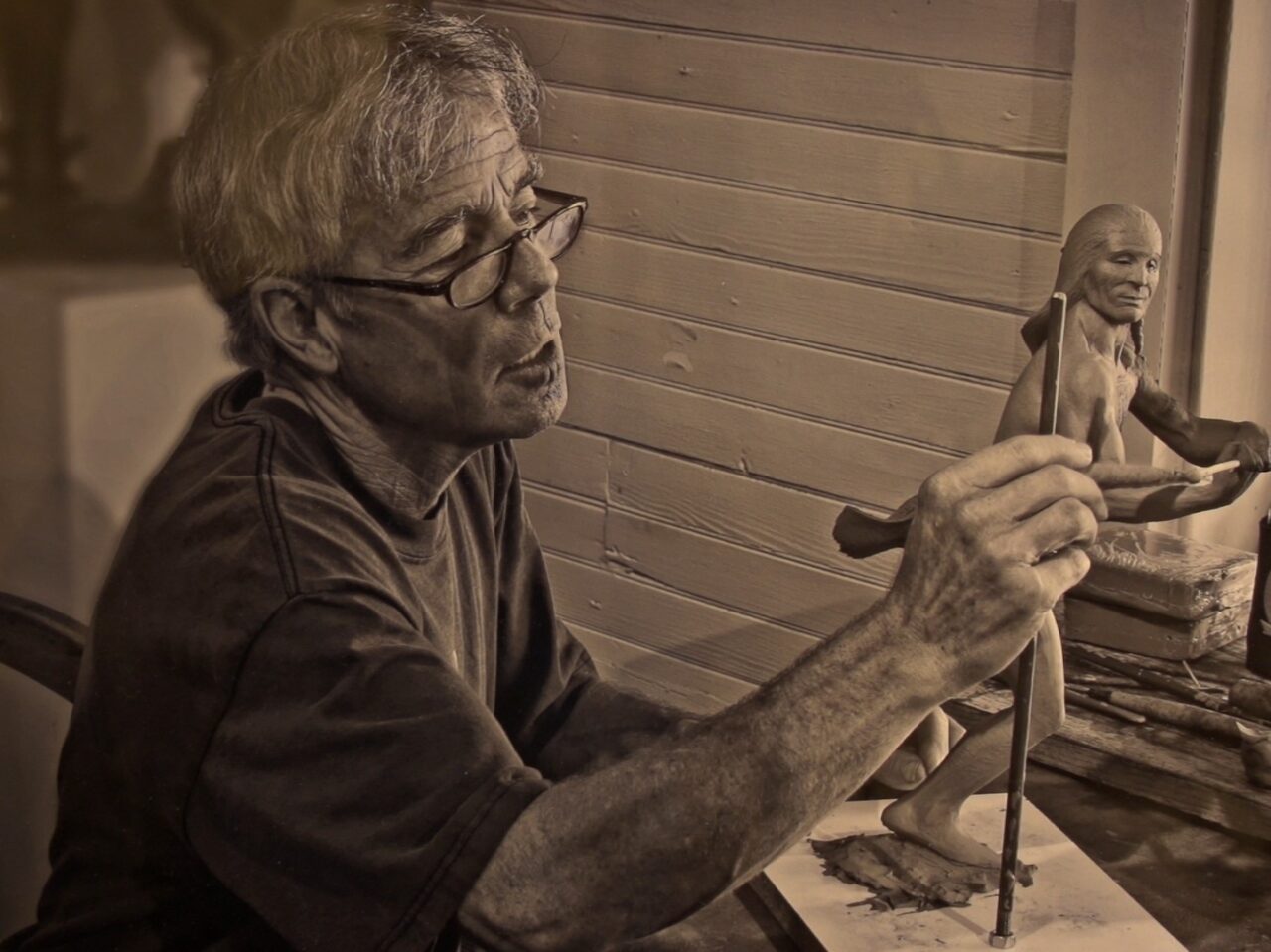
Serendipity came to the rescue in the form of a furniture maker working in the rainforest named Fletcher Pence who had worked with George Nakashima, the inventor of live-edge furniture. I thought, “Well, if I can’t paint, I’ll try woodcarving.” So I went to him and borrowed a mallet and a carving tool and purchased a piece of mahogany. The next day, on the beach with no expectations, I struck the chisel with the mallet one time and instantly something happened inside me. “This feels terrific!” I thought. By the end of that day I knew that my purpose in life was to be a sculptor. That was the day that I found out the ‘why’. I never took a class and never went to art school. I just seemed to intuitively know how to sculpt. From a variety of hardwoods, to stone, to marble and ultimately to modeling in clay and casting in bronze.
Ten years after that first carving I found out how this might all work. I had a wonderful conversation with my 92 year old maternal Irish grandmother just before she died and discovered from her something I had no knowledge of – that her grandfather was a marble sculptor!
Returning from the islands and informing my parents of my desire to make my living as a sculptor was not received with great enthusiasm, needless to say. I had recently met my future wife in Stowe, Vermont where she was an Alpine ski instructor and I was a Nordic ski instructor at the Trapp Family Lodge. For the two years I was there, I was Maria von Trapp’s personal instructor. We were spending the weekend with my parents in Bedford, NY before heading back to Vermont.
Fearing that we might well starve to death my father offered me a job in his company. That night I had a vivid dream-like vision of my possible future: I had taken that job, had reached late mid-life, and done very well financially but was absolutely miserable. I knew too late that I had wasted the gift that I had been given. The next morning before we headed north I thanked him for the offer, declined accepting it and said, “I don’t know if this will work but I have to at least make the attempt.”
Joseph Campbell, author of The Power of Myth and long time professor of Comparative Mythology at Sarah Lawrence College famously advised, “Follow Your Bliss.” His meaning: “align your life with your deepest sense of purpose, joy and authentic calling.” Campbell reminds us, “hard work and difficulties are still part of the journey.” Financial difficulties and dubious prospects were certainly part of our early journey. Fortunately my wife, Gretchen, was very supportive. One day I opened our checkbook to discover that we had $36 left to our name! “How will we pay the rent next month?” I wondered. Once I recovered from the initial shock I said to Gretchen, “Well this won’t take us very far anyway so let’s go out to dinner,” (back at a time when we could have a very nice meal for two at our favorite restaurant for $36).
After hard work and difficulties Joseph Campbell tells us, “Unexpected opportunities and people will appear to help us along.” Happily, for more than 40 years, this has been true for us. We have many people to thank who have helped us along.
In closing I would share a quote from one of my favorite sculptors, Michelangelo. “The greater danger is not that our hopes are too high and we fail to reach them, but they are too low and we do.”